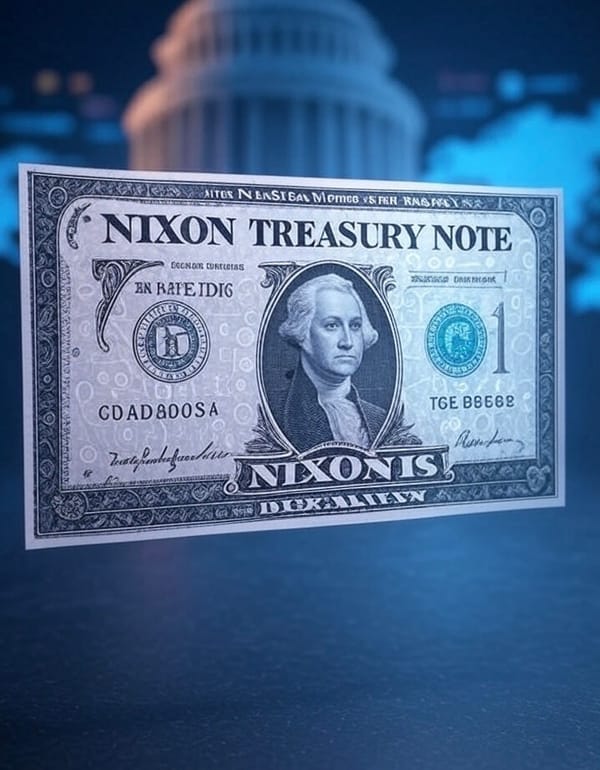
Empowering a Decentralized Future: A Hybrid Global Financial System for the United States


Mr. J. Nixon Joseph MBA,
JNJ & Associates LLC
71 Broadway
New York, NY 10006
@jnjconsultant
July 23, 2025
The Honorable Scott Bessent
Secretary of the Treasury
U.S. Department of the Treasury
1500 Pennsylvania Avenue, NW
Washington, DC 20220
Dear Secretary Bessent,
I am writing to submit a visionary proposal titled Empowering a Decentralized Future: A Hybrid Global Financial System for the United States for your review and consideration. This innovative plan integrates decentralized and centralized financial frameworks to modernize the U.S. financial system, enhance efficiency, promote financial inclusion, and drive economic growth.
The proposed system introduces Decentralized Treasury Bonds (DTBs) and a Centralized Digital US Dollar (cUSD), leveraging blockchain technology and smart contracts. Key projections include:
- DTBs capturing 5-10% of the $28 trillion Treasury market by 2028, saving $10-$20 billion annually in borrowing costs.
- cUSD achieving a $500 billion market cap by 2030, reducing transaction costs by 50-70% for cross-border payments.
- Economic impacts of $500 billion in GDP growth by 2030 through increased liquidity and improved monetary policy transmission.
The plan outlines a clear implementation roadmap, starting with regulatory frameworks and pilot programs in the next 12 months, scaling to widespread adoption by 2030. It addresses risks such as cybersecurity and geopolitical challenges while promoting financial inclusion for 50 million unbanked/underbanked Americans.
I respectfully request a formal review of this proposal by the Department of the Treasury and the National Economic Council. I am available to discuss the plan in detail or provide additional materials to support its evaluation. Please contact me at @Dividenddesk
Thank you for your time and consideration. This proposal represents a transformative opportunity to strengthen U.S. financial leadership in a rapidly evolving global economy.
Sincerely,
Mr. J Nixon Joseph Chairman and President
To: Scott Bessent
- Treasury:
Department of the Treasury, Office of Public Correspondence, 1500 Pennsylvania Avenue, NW, Washington, DC 20220
- White House
Office of Presidential Correspondence, The White House, 1600 Pennsylvania Avenue, NW, Washington, DC 2050
1. The Honorable Secretary of the Treasury
2. The White House - National Economic Council
Date: July 23, 2025
Executive Summary:
We propose a revolutionary hybrid global financial system for the United States, integrating decentralized and centralized frameworks to enhance efficiency, reduce risk, and drive economic growth. By leveraging blockchain-based Decentralized Treasury Bonds sm (DTBs) and a fiat-backed Centralized Digital US Dollar sm (cUSD), this system aims to modernize financial infrastructure, improve inclusion, and reinforce U.S. dollar dominance. Data projections suggest significant adoption and economic impact over the next decade.
Key Components:
- Decentralized Treasury Bonds (DTBs): Blockchain-based bonds to increase liquidity and reduce borrowing costs.
- Projection: By 2028, DTBs could capture 5-10% of the $28 trillion U.S. Treasury market, equating to $1.4-$2.8 trillion in issuance, driven by stablecoin reserve demand and institutional adoption. By 2030, DTBs could reduce borrowing costs by 0.5-1% annually, saving $10-$20 billion in interest payments based on projected $2 trillion annual Treasury issuance.
- Centralized Digital US Dollar (cUSD): A fiat-backed digital currency for efficient transactions and reserve management.
- Projection: cUSD could achieve a market capitalization of $500 billion by 2030, representing 10-15% of M2 money supply ($21 trillion in 2025), with 20-30% adoption in cross-border payments and remittances, reducing transaction costs by 50-70% compared to traditional systems.
3. Smart Contracts: Automating DTB issuance, trading, settlement, and cUSD collateralization.
- Projection: Smart contract platforms could process $1 trillion in DTB transactions annually by 2030, with 99% reduction in settlement times (from days to minutes) and 80% cost savings in bond issuance and management.
4. Digital Asset Reserve: Centralized store of digital assets for monetary policy management.
- Projection: By 2030, the Digital Asset Reserve could hold $300-$500 billion in digital assets, including cUSD and tokenized Treasuries, stabilizing monetary policy transmission and supporting 5-10% of Federal Reserve balance sheet operations.
5. Decentralized Network: Blockchain-based platform for international transactions and data sharing.
- Projection: The network could facilitate $5 trillion in annual cross-border transactions by 2030, capturing 15-20% of global trade settlements, with 90% of transactions achieving real-time settlement compared to 2-5 days currently.
Implementation Roadmap:
1. Short-term (0-12 months):
- Establish regulatory frameworks with the Treasury, SEC, and Federal Reserve, aligning with stablecoin legislation like the GENIUS Act.
- Develop DTB and cUSD infrastructure, piloting with $50 billion in DTBs and $100 billion in cUSD issuance by Q3 2026.
- Projection: Pilot programs could attract 10-15% of institutional investors (e.g., BlackRock, JPMorgan) and 5% of retail investors, with $10 billion in DTB subscriptions and $20 billion in cUSD circulation within 12 months.
2. Mid-term (12-24 months):
- Launch DTBs and cUSD, integrating with major financial platforms (e.g., Visa, Stripe).
- Develop smart contract platforms for automated issuance and settlement.
- Projection:DTB adoption could reach $200-$400 billion, and cUSD circulation could hit $150 billion, with 25% of U.S. banks adopting cUSD for payments by Q3 2027.
3. Long-term (24-60 months):
- Achieve widespread adoption, targeting 50% of Treasury issuance as DTBs and 20% of U.S. payments via cUSD.
- Continuously evaluate and optimize system performance.
- Projection: By 2030, DTBs could represent 20% of Treasury holdings ($5.6 trillion), and cUSD could process $2 trillion in annual transactions, surpassing traditional payment networks like SWIFT in efficiency.
Benefits:
1. Increased Efficiency:
- Projection: Transaction costs could decrease by 60-80%, saving $100-$150 billion annually across Treasury and payment systems by 2030. Settlement times for international transactions could drop from days to seconds.
2. Improved Financial Inclusion:
- Projection: cUSD could provide financial services to 50 million unbanked/underbanked Americans by 2030, with 30% adoption in underserved regions, reducing reliance on costly intermediaries.
3. Enhanced Security:
- Projection: Blockchain immutability and smart contract audits could reduce fraud by 90%, saving $20-$30 billion annually in financial crime losses.
4. Economic Growth:
- Projection: Increased liquidity from DTBs could lower Treasury yields by 10-20 basis points, stimulating $500 billion in GDP growth by 2030. cUSD could boost global dollar dominance, increasing U.S. share of FX reserves by 5%.
Risks and Mitigation:
- Cybersecurity: Implement quantum-resistant cryptography and regular audits to protect DTBs and cUSD.
- Volatility: Ensure full-reserve backing for cUSD and stress-test DTB liquidity to prevent market disruptions.
- Geopolitical: Promote cUSD adoption globally to counter de-dollarization trends, maintaining U.S. financial leadership.