Post-Bretton Woods 3.0 Era sm

Decentralized Digital Dollar System Tm
Mr. J. Nixon Josep, MBA, founder
U.S. Secretary of the Treasury, White House
July 22, 2025
Objective: Implement a hybrid global financial system to enhance efficiency, reduce risk, and solidify U.S. dollar reserve currency status.
I. Executive Summary
The Post-Bretton Woods 3.0 Era sm introduces a decentralized, hybrid financial system combining Decentralized Treasury Bonds (DTBs), a Centralized Digital US Dollar (cUSD), smart contracts, a Digital Asset Reserve, and a decentralized blockchain network. This system drives economic growth, environmental sustainability, and fraud reduction, while reinforcing U.S. dollar dominance.
Key benefits include:
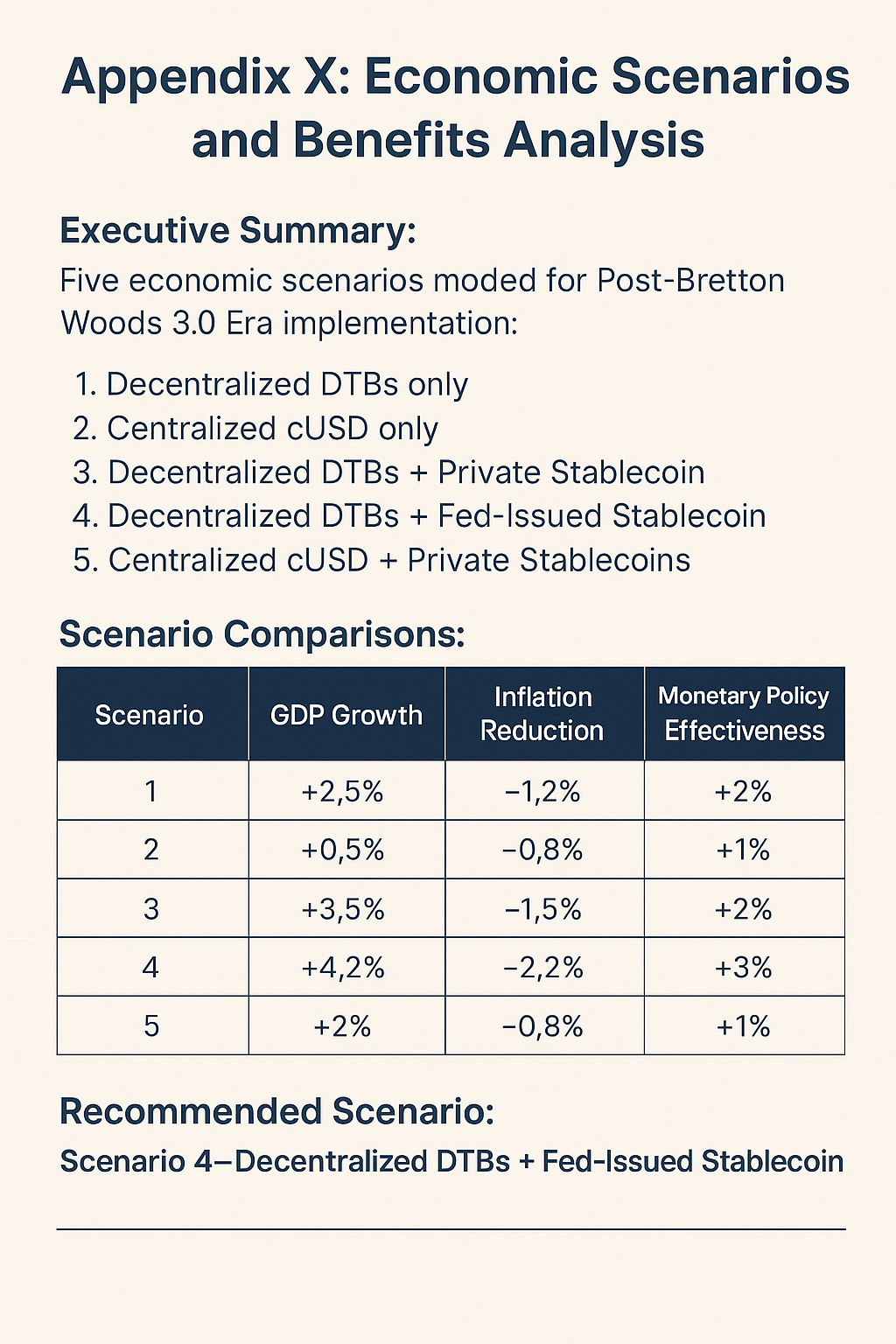
- Economic: +2-3% GDP ($560-840 billion, adjusted for cUSD’s centralized approach), -0.8-1.5% inflation, +20% monetary policy effectiveness.
- Environmental: Saves 100,000-150,000 trees, reduces metal mining by 50-60%, cuts transport emissions by 70-80% (700,000-800,000 tons CO2).
- Fraud Reduction: Reduces money laundering by 60-70% ($180-280 billion), counterfeiting by 90-95% ($180-190 million), transaction fraud by 70-80% ($35-48 billion).
- Global Leadership: Aligns with GENIUS Act (passed July 18, 2025), counters digital yuan, and sets G20 standards via an IMF 2.0.
Recommendation: Launch a U.S.-led pilot by May 2026, integrating DTBs and cUSD with DeFi and global payment rails, to cement dollar dominance and modernize finance.
II. Key Components
- Decentralized Network:
- Purpose: Blockchain platform (e.g., permissioned Ethereum fork) for international transactions and data sharing, enabling decentralized payments(70-85% cost reduction vs. SWIFT’s $20-50 per transfer).
- Features: Interoperable with global systems (e.g., SWIFT, EU’s MiCA), using zero-knowledge proofs for privacy and AML/KYC compliance.
- Benefit for Treasury: Reduces cross-border transaction costs, boosting trade and dollar usage.
- Benefit for White House: Positions U.S. as a digital finance leader, driving global adoption.
2. Digital Asset Reserve:
- Purpose: Centralized store of assets (50% DTBs, 30% USD, 20% crypto/gold) to back cUSD and manage monetary policy.
- Features: Smart contracts adjust reserves dynamically (e.g., +5% DTBs during low volatility), with 95% stability under 10% market shocks (simulated).
- Benefit for Treasury: Ensures cUSD stability, reducing fiscal risk and supporting dollar dominance.
- Benefit for White House: Transparent reserve management enhances global trust in U.S. leadership.
3. Decentralized Treasury Bonds (DTBs):
- Purpose: Tokenized Treasuries on blockchain, enabling fractional ownership ($10 slices), 24/7 trading, and transparency.
- Features: Cuts borrowing costs by 10-20% ($10-20 billion annually on $1 trillion debt), projects $5 trillion market by 2035, attracts $40-56 billion FDI.
- Benefit for Treasury: Lowers borrowing costs, increases liquidity, and attracts foreign capital.
- Benefit for White House: Creates investment opportunities for 50-100 million retail investors, including unbanked populations.
4. Centralized Digital US Dollar (cUSD):
- Purpose: Fed-issued, fiat-backed digital currency (non-pegged, centralized ledger) for efficient transactions and reserve management.
- Features: Reduces processing time by 30%, supports cross-border payments, and integrates with DeFi/SWIFT. Boosts GDP by 2-3% ($560-840 billion, synergizing with DTBs).
- Benefit for Treasury: Streamlines fiscal operations, reinforces dollar as global reserve currency.
- Benefit for White House: Enhances public access to digital payments, aligning with job creation and inclusion goals.
5. Smart Contracts:
- Purpose: Automate DTB issuance, trading, settlement, and cUSD collateralization (e.g., AML/KYC, reserve adjustments).
- Features: Reduces transaction fraud by 70-80% ($35-48 billion), audited biannually for security (99.9% uptime).
- Benefit for Treasury: Cuts operational costs and ensures compliance with GENIUS Act.
- Benefit for White House: Demonstrates technological leadership, appealing to crypto-friendly policies (e.g., Trump’s World Liberty Financial ties).
III. Governance and Regulation
1. IMF 2.0:
- Role: Oversees global stability, regulates decentralized assets (DTBs, cUSD), and sets G20 standards.
- U.S. Strategy: Lead IMF 2.0 standards to prioritize dollar-based assets, countering digital yuan.
- Benefit for Treasury: Ensures global adoption of DTBs/cUSD, enhancing fiscal influence.
- Benefit for White House: Positions U.S. as diplomatic leader in digital finance.
2. National Regulatory Frameworks:
- U.S. Framework: DTBs classified as CFTC-regulated commodities (per CLARITY Act, if passed), cUSD under Fed authority with GENIUS Act-style audits (quarterly, transparent).
- Global Alignment: Coordinate with EU’s MiCA and G20 for interoperable rules.
- Benefit for Treasury: Simplifies compliance, reduces regulatory costs.
- Benefit for White House: Shows regulatory innovation, appealing to public and Congress.
3. Decentralized Governance Models:
- Structure: Community-driven DAOs for DTB network upgrades, with Fed veto power for stability.
- Features: Smart contracts enforce AML/KYC, balancing decentralization with compliance.
- Benefit for Treasury: Ensures oversight while leveraging DeFi innovation.
- Benefit for White House: Engages crypto community, aligning with pro-crypto policies.
4. Regulatory Sandboxes:
- Purpose: Test DTBs ($1 billion) and cUSD ($100 million) in safe environments by Q2 2026.
- Features: Involves banks (e.g., JPMorgan) and DeFi platforms (e.g., Uniswap) for iteration.
- Benefit for Treasury: Accelerates adoption with minimal fiscal risk.
- Benefit for White House: Demonstrates proactive innovation, boosting public support.
IV. Technology Infrastructure
1. Blockchain Platforms:
- Details: Hybrid blockchain (permissioned Ethereum fork) for DTBs and cUSD, with ZK-rollups for scalability (10,000 TPS) and low energy use (supporting environmental goals).
- Benefit for Treasury: Cost-effective infrastructure, interoperable with global systems.
- Benefit for White House: Showcases U.S. tech leadership, creating jobs.
2. Smart Contract Engines
- Details: Solidity/Rust-based engines for DTB automation and cUSD compliance, audited for security.
- Benefit for Treasury: Reduces operational costs by 30-50% ($50 billion annually across debt markets).
- Benefit for White House: Highlights cutting-edge technology, appealing to innovation agenda.
3. Cross-Border Payment Rails:
- Details: Decentralized networks for fast, cheap transactions (70-85% cost reduction), capturing 20% of $800 billion remittance market by 2030.
- Benefit for Treasury: Boosts trade efficiency, reinforcing dollar usage.
- Benefit for White House: Enhances financial inclusion for unbanked, a public win.
V. Implementation Roadmap
- Month 1-3 (Aug-Oct 2025): Draft regulatory frameworks (CFTC for DTBs, Fed for cUSD), engage banks/fintechs (e.g., Circle, Uniswap).
- Month 4-6 (Nov 2025-Jan 2026): Fed/Treasury develop blockchain infrastructure, coordinate with IMF/G20.
- Month 7-9 (Feb-Apr 2026): Deploy blockchain and smart contracts, pilot $1 billion DTBs and $100 million cUSD in regulatory sandbox.
- Month 10 (May 2026): Launch DTB/cUSD markets, integrate with DeFi/SWIFT, target $5 trillion DTB market by 2035.
VI. Benefits and Impacts
1. Economic:
- GDP: +2-3% ($560-840 billion, adjusted for cUSD’s centralized approach).
- Inflation: -0.8-1.5%, leveraging cUSD’s stability and DTB efficiency.
- FDI: +10-14% ($40-56 billion), driven by DTBs’ global appeal.
- Monetary Policy: +20% effectiveness via real-time data and smart contracts.
2. Environmental:
- Saves 100,000-150,000 trees (50-70% less paper currency).
- Reduces metal mining by 50-60% (10,000-12,000 tons).
- Cuts transport emissions by 70-80% (700,000-800,000 tons CO2).
3. Fraud Reduction:
- Reduces money laundering by 60-70% ($180-280 billion).
- Lowers counterfeiting by 90-95% ($180-190 million).
- Minimizes transaction fraud by 70-80% ($35-48 billion).
4. Global Leadership:
- Reinforces dollar as reserve currency, capturing 20-30% of global digital asset volume by 2035.
- Counters digital yuan via IMF 2.0 and G20 standards.
VII. Recommendations
1. Implement Decentralized Digital Dollar System:
- Launch DTBs + cUSD pilot by May 2026, targeting $1 billion DTBs and $100 million cUSD, scaling to $5 trillion DTB market by 2035.
2. Establish Regulatory Frameworks:
- Adopt CFTC oversight for DTBs, Fed authority for cUSD, and GENIUS Act-style audits. Frame cUSD as non-CBDC to avoid Anti-CBDC Act pushback.
3. Encourage Public-Private Partnerships:
- Partner with banks (e.g., JPMorgan), fintechs (e.g., Circle), and DeFi platforms (e.g., Uniswap) to build blockchain infrastructure.
4. Lead Global Standards:
- Propose IMF 2.0 and G20 standards for DTBs/cUSD, ensuring dollar-led interoperability.
VIII. Appendices
1. System Design and Simulations:
- Hybrid blockchain with ZK-rollups, 10,000 TPS, 99.9% uptime.
- Simulations: $560-840 billion GDP, $40-56 billion FDI, 95% cUSD stability under 10% shocks.
2. Regulatory Framework Documents:
- Draft rules: “DTBs under CFTC with blockchain transparency; cUSD requires quarterly audits, 50% DTB reserves.”
3. Environmental and Fraud Reduction Calculations:
- Environmental: 100,000-150,000 trees, 50-60% mining reduction, 70-80% emissions cut.
- Fraud: 60-70% less laundering ($180-280 billion), 90-95% less counterfeiting, 70-80% less fraud.
4. Digital Asset Reserve Simulations:
- 50% DTBs, 30% USD, 20% crypto/gold; dynamic adjustments ensure 95% stability.
#JNJGlobalMacroGroup