Strategic Missteps in the “Golden Age of Crypto”

📄 EXECUTIVE MEMORANDUM:
A Concerned Wall Street Analyst
To : The White House, National Economic Council, Treasury Department, Federal Reserve
Date : July 31, 2025
Subject: Strategic Missteps in the “Golden Age of Crypto” Roadmap
Distribution: Policy, Finance, and Institutional Markets Leadership
Executive Summary
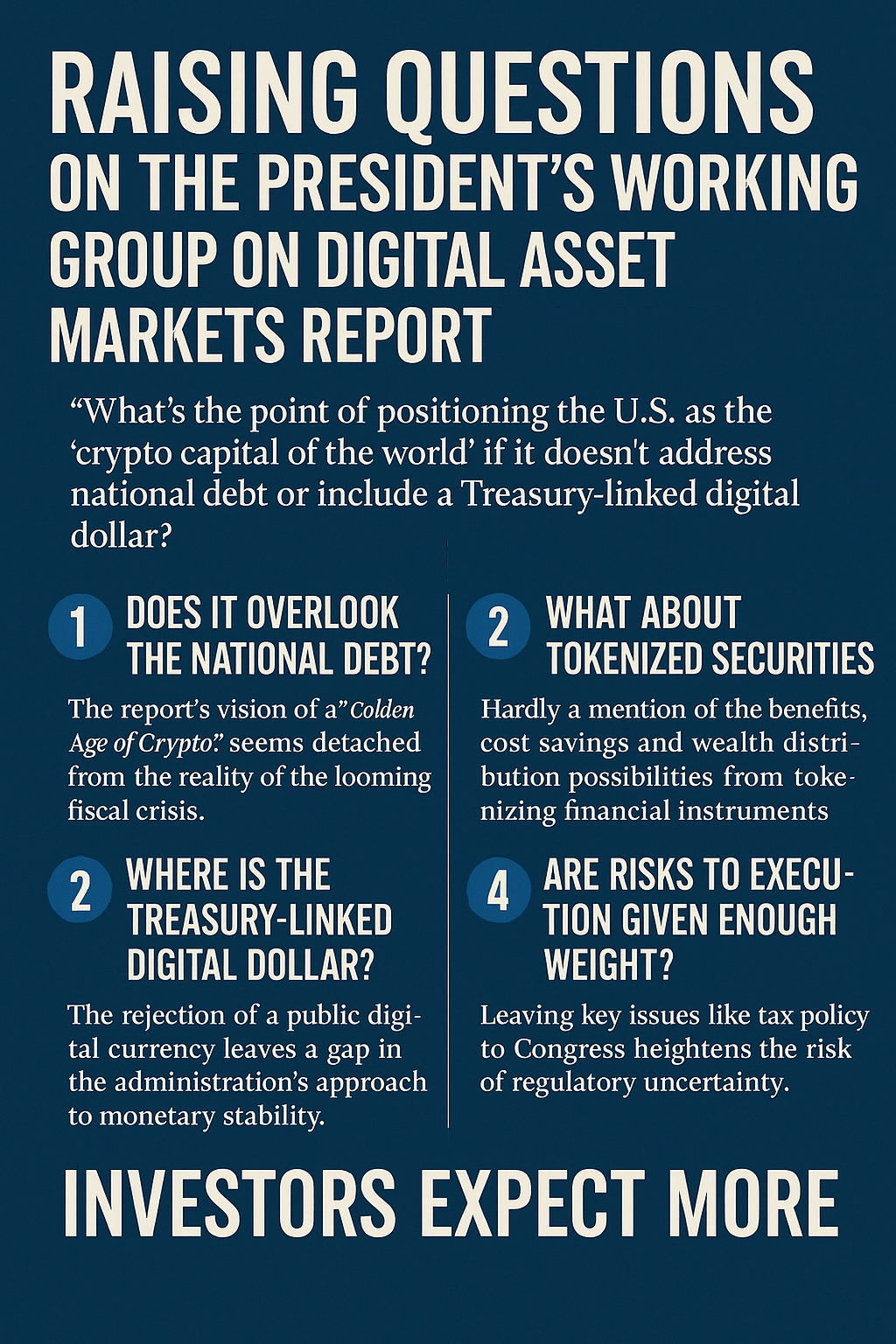
The President’s Working Group on Digital Asset Markets (PWG) aims to establish the United States as the "crypto capital of the world." While the effort emphasizes innovation and regulatory clarity, it overlooks the two most pressing financial imperatives of the decade: addressing the $35 trillion national debt and developing a Treasury-linked digital dollar. This memo outlines key shortcomings in the PWG roadmap and presents five actionable recommendations to realign the strategy with institutional markets and long-term fiscal health.
1. Crypto Capital Without Fiscal Reform? A Hollow Vision
The report is aspirational but fails to confront fiscal realities. With national debt at $35 trillion, blockchain should be harnessed not just for retail innovation but for debt issuance, settlement efficiency, and investor diversification.
Missed Opportunity: The report gives scant attention to tokenized Treasuries, a market innovation that could significantly lower borrowing costs, attract global capital, and increase liquidity for U.S. debt markets.
Private sector cryptocurrencies like Bitcoin and stablecoins do not address sovereign financing needs. Bitcoin remains speculative and untethered from policy levers. Stablecoins, while functional, generate profits for private issuers, not the public Treasury.
2. Digital Dollar Rejection Undermines Monetary Sovereignty
The Administration’s support for the Anti-CBDC Surveillance State Act effectively sidelines any discussion of a digital dollar, ceding the field to private issuers like Tether and Circle.
Institutional Risk: Stablecoins, even when regulated, are corporate IOUs—they introduce counterparty risk, fragment the market, and divert monetary power away from public institutions.
A Treasury- or Fed-issued digital dollar could:
- Anchor blockchain innovation with risk-free settlement
- Reinforce global dollar dominance
- Modernize cross-border payments and reduce FX costs
Wall Street prefers transparent, liquid, sovereign assets. A public digital dollar would serve as a trusted foundation for both DeFi and TradFi integrations—private stablecoins cannot fulfill this role alone.
3. Silence on Tokenized Securities: A Strategic Blind Spot
The report offers no concrete roadmap for tokenizing traditional securities—despite this being one of blockchain’s most promising institutional use cases.
Reality Check: BlackRock’s tokenized BUIDL fund has surpassed $500 million AUM, and JPMorgan is actively using Onyx for real-world asset (RWA) tokenization. Markets are moving—regulators are not.
Wall Street needs:
- Clear SEC/CFTC frameworks for tokenized equities and bonds
- Pilot programs in collateralized lending and repo markets
- Integration into the clearing and custody ecosystem
Without this, the U.S. risks falling behind jurisdictions like Singapore, Switzerland, and the EU, who are aggressively moving forward with real-world asset tokenization policies.
4. Overweight Bitcoin, Underweight Infrastructure
The report places outsized emphasis on Bitcoin and stablecoins—assets more relevant to retail speculation than macro policy or institutional finance.
Bitcoin’s volatility and lack of correlation to fiscal objectives limit its policy utility. Meanwhile, stablecoins are structurally dependent on the fiat system they do not strengthen.
Instead of building infrastructure for national resilience, the report reads as a roadmap for private-sector monetization of dollar liquidity.
5. Execution Gaps and Market Apathy
The market response says it all:
- Bitcoin remains stable at ~$66,000
- Crypto ETF flows have stalled
- Institutional adoption is muted
This reflects a lack of confidence in the roadmap’s execution. Reliance on Congressional action, ongoing regulatory turf wars, and unclear timelines all create uncertainty—Wall Street’s least favorite variable.
Strategic Recommendations
1. Launch Tokenized Treasury Pilot ProgramsImplement a Treasury-led pilot to issue blockchain-native government bonds, improving capital access and lowering servicing costs.
2. Reintroduce a Privacy-Protected Digital DollarDesign a Treasury-linked digital dollar with built-in privacy layers, ensuring U.S. monetary sovereignty and fostering systemic trust.
3. Provide Clear Guidance on Tokenized SecuritiesDirect the SEC and CFTC to jointly issue a framework on RWA tokenization, including disclosure standards, custody protocols, and compliance models.
4. Connect Crypto Growth to Fiscal PolicyPropose mechanisms—like blockchain transaction taxes, efficiency savings, or capital gains alignment—that link digital asset expansion to deficit reduction.
5. Commit to a 90-Day Regulatory RoadmapRoll out a concrete implementation plan for regulatory sandboxes, tax treatment clarity, and digital infrastructure, signaling seriousness to markets.
Conclusion
The current roadmap nods to innovation but misses the opportunity to deploy blockchain toward systemic reform. Without Treasury integration, tokenized sovereign assets, or a digital dollar, the “crypto capital” branding lacks substance.
Wall Street supports innovation—but it demands execution, scale, and alignment with fiscal strategy. The Administration must go beyond marketing and deliver a digital asset framework that can strengthen America’s balance sheet and lead global markets.