The Digital Nixon Treasury Note and Tokenized Bonds: A Blueprint for Dollar Dominance in the Digital Age

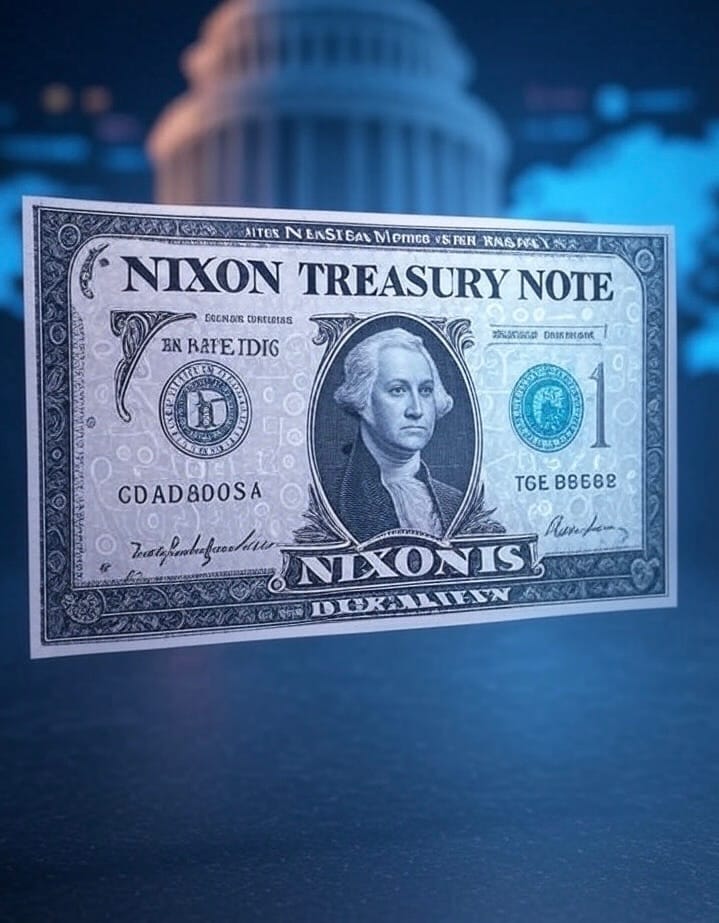
To: The White House, Federal Reserve, U.S. Treasury, Investors, and Corporate Leaders
Date: August 15, 2025
As the global financial landscape shifts toward digital currencies, with China’s digital yuan (e-CNY) and other central bank digital currencies (CBDCs) vying for influence, the United States has a unique opportunity to reinforce dollar dominance through a hybrid digital asset system: the Digital Nixon Treasury Note (DNTN) and tokenized Treasury bonds. Designed to supplement the U.S. dollar, this system combines centralized stability with decentralized innovation, leveraging U.S. legal transparency and a robust digital identity framework to outpace rival CBDCs. By driving global adoption, this initiative can lower borrowing costs, boost economic growth, and slow the growth of the $35 trillion national debt.
Design of the DNTN and Tokenized Bonds
Digital Nixon Treasury Note (DNTN)
The DNTN is a Fed-issued, dollar-pegged digital asset on a permissioned blockchain (e.g., Hyperledger Fabric), offering 2-4% yields and full convertibility to dollars. Key features include:
- Architecture: A high-throughput (15,000 TPS) blockchain with 150 nodes operated by the Fed and trusted partners (e.g., JPMorgan, HSBC). It uses zero-knowledge proofs (ZKPs) for privacy and post-quantum cryptography for security.
- Accessibility: Delivered via the FedWallet app, with biometric login, offline QR code transactions, and integration with global payment systems (e.g., SWIFT, FedNow).
- Transparency: Publicly verifiable audit trails, certified by third parties (e.g., PwC), align with U.S. legal standards, contrasting with the e-CNY’s opaque surveillance model.
- Use Cases: Retail payments, cross-border trade, savings, and stimulus distribution.
Tokenized Treasury Bonds
Tokenized bonds are U.S.-backed securities on public blockchains (e.g., Ethereum, Solana), integrated with DeFi platforms. Features include:
- Architecture: Open-source smart contracts, audited by Certik, with self-sovereign identity (SSI) for decentralized access. They support 50,000 TPS and cross-chain interoperability.
- Accessibility: Fractionalized ($1 increments) for retail investors, offering 5-7% DeFi yields via lending protocols (e.g., Aave).
- Transparency: Open-source credentials and U.S.-regulated KYC/AML checks ensure trust, unlike rival CBDCs’ regulatory gaps.
- Use Cases: DeFi collateral, liquidity pools, and institutional portfolios.
Digital Identity System
A unified digital identity system underpins both assets, ensuring security and compliance:
- DNTN Identity: Biometric KYC via FedWallet, using ZKPs for privacy and FinCEN-compliant verification. It supports 500 million users, with offline capabilities for emerging markets.
- Tokenized Bond Identity: SSI via crypto wallets (e.g., MetaMask), with smart contract KYC and SEC compliance, scaling to 1 billion DeFi users.
- Transparency and Security: Audited systems, quantum-resistant cryptography, and AI-driven fraud detection leverage U.S. legal oversight, outpacing e-CNY’s surveillance and digital euro’s delays.
Countering Rival CBDCs
The DNTN and tokenized bonds are designed to compete with rival CBDCs, particularly the e-CNY, which has 300 million users and $100 billion in transactions. Strategies include:
- Technological Edge: The DNTN’s 15,000 TPS and tokenized bonds’ 50,000 TPS surpass the e-CNY’s 10,000 TPS, with lower fees (<0.1% vs. e-CNY’s 0.5%).
- Privacy and Transparency: ZKPs and audited systems counter the e-CNY’s surveillance, appealing to democratic markets (e.g., EU, Japan). U.S. legal protections build trust vs. China’s opacity.
- Global Adoption: Partnerships with G7 nations, integration with SWIFT, and pilots in BRI countries (e.g., Nigeria) target $500 billion in adoption by 2030, capturing 10-20% of the $5 trillion digital currency market.
- DeFi Innovation: Tokenized bonds’ 5-7% yields in DeFi outpace the e-CNY’s zero returns and digital euro’s savings focus, attracting crypto-native users.
Economic Impacts on U.S. Debt
This hybrid system indirectly supports national debt management:
- Lower Borrowing Costs: Global adoption ($500 billion-$1 trillion) increases demand for U.S. debt, lowering Treasury yields by 0.2-0.5%, saving $70-175 billion annually in interest on a $35 trillion debt.
- Economic Growth: Enhanced transaction efficiency and financial inclusion add 0.2-0.5% to GDP ($25-60 billion in tax revenue), narrowing deficits.
- Seigniorage: Foreign holdings generate $10-20 billion annually, offsetting debt issuance.
- Net Impact: These factors reduce the annual deficit by $100-250 billion, lowering the debt-to-GDP ratio by 2-5% over a decade (e.g., 120% to 115-118%).
Implementation Roadmap
- Year 1 (2026): Launch DNTNs via FedWallet and tokenized bonds on Coinbase/Aave, targeting $75 billion in U.S. adoption. Market U.S. transparency on X.
- Years 2-3 (2027-2028): Expand to Japan, UK, and Singapore, integrating with local systems, aiming for $200 billion in holdings.
- Years 4-5 (2029-2030): Target BRI countries and lead FATF standards, achieving $500 billion in global adoption, with $150 billion in annual deficit reduction.
Call to Action
The DNTN and tokenized bonds offer a strategic opportunity to maintain U.S. dollar dominance in the digital era. We urge the White House, Federal Reserve, and Treasury to:
1. Authorize Development: Fund the DNTN blockchain and digital identity system, leveraging U.S. transparency.
2. Engage Investors: Partner with banks and DeFi platforms to drive adoption.
3. Lead Globally: Advocate for digital currency standards at G20 and FATF, countering rival CBDCs.
By acting swiftly, the U.S. can secure its financial leadership, strengthen the economy, and manage the national debt effectively. Let’s seize this moment to shape the future of global finance.
Notes for Stakeholders:
- For further details or to collaborate on implementation, contact @Dividenddesk.
- Join our webinar series on X to explore the DNTN’s potential, starting September 2025.